The Small-Kitchen Knife: Blade, Board, and Safe Storage
A useful everyday knife is a combination of blade, board, and storage. Choose for the work you actually do, then give the knife a stable place that keeps it accessible without crowding the kitchen.
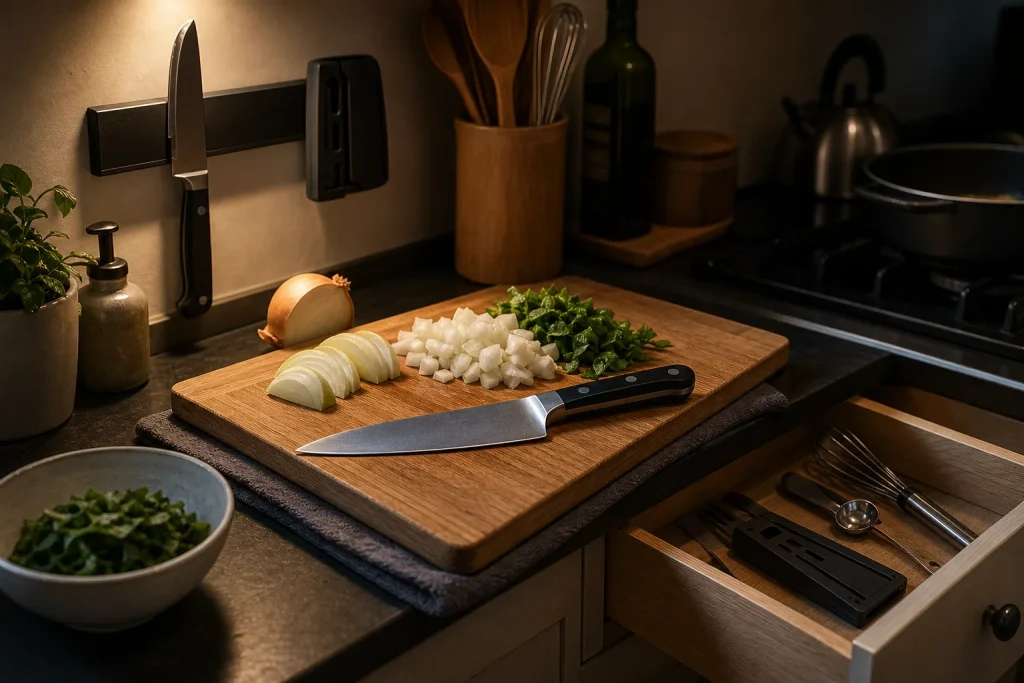
A useful everyday knife is a combination of blade, board, and storage. Choose for the work you actually do, then give the knife a stable place…
Tools · 5 min read
The common mistake is choosing a knife for its impressive blade, then leaving it loose in a crowded drawer. The edge can strike other utensils, the handle can disappear beneath them, and reaching in becomes an avoidable hazard. In a small kitchen, the knife, board, and storage place need to fit together.
Match the Work
For ordinary weeknight prep, look for a knife that feels controlled while slicing an onion, trimming a pepper, and cutting cooked chicken. A chef’s knife is versatile, but its popularity does not make it right for every hand or counter. A shorter chef’s knife or a santoku may be easier to guide in a narrow workspace.
Notice how the handle sits in your hand. Your fingers should feel comfortable without pressing against the blade’s heel. If the handle feels slick, bulky, or hard to hold securely, consider another shape. There is no single profile that suits every cook.
Blade material affects care. Stainless steel generally tolerates ordinary kitchen use with prompt washing and drying. Carbon steel needs especially prompt drying and more attention to prevent discoloration or rust. Choose the material whose care suits your routine, and follow the manufacturer’s instructions.
Fit the Board
A large board that takes over the counter may not be practical. Choose one that leaves room for a bowl or pan while keeping sliced food on the surface. It should sit fully on the counter, not balance across a sink or burner.
Wood and plastic can both work when clean and in good condition. For either material, wash the board after use with hot, soapy water, rinse it, and let it dry thoroughly. Avoid soaking a wooden board or leaving it wet in a stack; follow its care instructions. For raw meat, poultry, seafood, or eggs, keep the board separate from ready-to-eat foods such as salad ingredients. Use a separate board when available, or wash and sanitize the board before using it for ready-to-eat food. Follow the board maker’s care directions and the label on any food-contact sanitizer; do not mix cleaning products. Retire a board if deep grooves, cracks, or other damage make it difficult to clean.
Keep the board from sliding by placing a damp, wrung-out towel or a purpose-made nonslip mat underneath. The towel should lie flat, without bunching under a corner. If the board shifts during cutting, stop and reset it before continuing.
Keep the Kit Small
Start with one everyday knife. Add a small paring knife only if your cooking regularly calls for close, handheld trimming. A chef’s knife can handle most board work, including herbs, vegetables, and boneless meat. A paring knife can peel an apple or trim a small blemish, but use a stable board for firm foods rather than holding them in your hand.
Say you cook a quick vegetable-and-egg supper in a narrow rental kitchen. You choose a compact chef’s knife that feels comfortable, set a medium board on a damp towel, and slice the onion and greens in manageable batches. The expected result is a stable patch of prep space without several specialized blades taking up room.
Keep the knife in working order. A honing rod can help realign an edge during routine care; sharpening removes material to restore a dulled edge. If you are unsure how to use either safely, follow the maker’s directions or ask a knowledgeable knife shop. If a knife is dull or damaged, pause and address it rather than forcing it through a tomato or squash.
Choose Safe Storage
A crowded drawer is a poor home for an unprotected blade. If a drawer is your only practical option, use a blade guard or fitted in-drawer tray that keeps the edge apart from other utensils. Put the knife away dry, secure the guard, and never reach into a drawer blindly.
A magnetic strip can free drawer space, but it needs a firm mounting surface and a position away from routine bumps. Install it according to its instructions, check that the knife sits securely, and keep the edge turned away from casual contact. If mounting is unsuitable, a countertop block may work if it does not crowd the cutting area or sit where it can be knocked over.
A blade guard is a compact option for many small kitchens. Choose one that fits without exposing the tip or letting the knife slide out. Store the guarded knife where it will not be pinned beneath heavy cookware.
Build Safe Habits
Use the knife on a board, not on a plate, countertop, or inside a pot. Curl the fingertips of your holding hand back and cut at a pace you can control. If the board shifts, stop and reset the towel or mat before continuing.
After prep, wash the knife carefully by hand, keeping the blade pointed away from your fingers. Dry it promptly and return it to its guard, tray, or secure holder. Do not leave it submerged in a sink of soapy water, where it can disappear from view among dishes. A knife is like a pair of scissors: useful when it has a known place, troublesome when it is loose in a pile.
Before buying, decide where the knife will live and how the board will sit beside it. If the storage plan requires clearing most of a drawer or sacrificing the only landing space beside the stove, reconsider the arrangement. A useful small-kitchen knife is one you can grip comfortably, use on a stable board, clean appropriately, and put away safely.
A little more to cook with
Wood, Iron, and Supper: Keeping a Survival Crew Supplied
Four players reach their riverside shelter with thirty logs, six iron ore, eight meals, and almost…

Sunday’s Cooked Beans, Tuesday’s Fast Bowl
A small batch of cooked beans can make a weeknight bowl feel nearly assembled. Cook them…